How the Crypto Market Ecosystem Works
Unlike traditional financial markets, crypto-asset markets are continuous. Crypto-assets can be purchased and sold at any time; unlike traditional markets that have set hours for trading, crypto-markets run continuously. Continuous trading influences price movement, formation of liquidity, and response to information among participants in the marketplace.
To understand the overall crypto-ecosystem, it is necessary to consider multiple aspects simultaneously. Digital assets, exchanges, wallets, decentralized networks and market structure all play a part in how the marketplace functions. How users interact with the blockchain based financial infrastructure will depend upon the interplay of these elements.
The Emergence of Digital Assets
A digital asset represents value that is encoded using cryptography and stored on a blockchain. Digital assets became well-known with the launch of Bitcoin in 2009, and allowed a decentralized digital currency to exist.
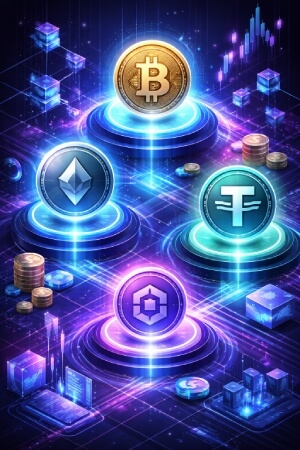
Bitcoin was created to provide a peer-to-peer electronic monetary system. Users of the Bitcoin network could transfer value without needing a banking institution or payment processing service to facilitate the transaction. Miners would validate transactions by contributing computational resources to maintain the integrity of the network.
Over 5 years after the introduction of Bitcoin, there have been over 10,000 new digital assets developed. While some digital assets were created to act as a form of currency, many were designed to support decentralized applications, and/or provide utility to other digital assets within the blockchain ecosystem.
Many digital assets are classified under several categories. Categories help describe how various tokens perform different functions within the larger ecosystem.
Major Types of Digital Assets
Digital Assets are divided into four categories:
- Value Transfer and Store of Value - Most notably Bitcoin. These types of digital assets were created to be used as an alternative form of currency (value transfer) and to serve as a hedge against inflation (store of value).
- Decentralized Applications Built Using Blockchain Platforms - Most notably Ether. These types of digital assets were created to provide funding for decentralized applications (dApps), which can run autonomously on blockchain platforms.
- Stablecoins - Designed to stabilize the market value of a digital asset, these types of digital assets typically link their market values to a stable asset, most commonly national currencies.
- Utility Tokens - Allow users to purchase services or features that exist on digital platforms. For example, a user may use a utility token to buy a service offered on a social media platform.
These categories reflect the different design goals for each type of digital asset. Some digital assets were created to facilitate the process of making and receiving payments, while others were created to build out the infrastructure of a blockchain network or to create a decentralized application (dApp).
How Blockchain Networks Support Cryptocurrency
Blockchain Networks are the backbone of digital assets, providing the infrastructure to create, maintain, and update a digital asset's transactional history. The blockchain network is essentially a ledger that stores all of the data associated with each digital asset transaction.
The ledger is decentralized, meaning that it is maintained by multiple nodes on the network. Each node has its own copy of the blockchain and each node plays a role in validating the addition of new data to the blockchain. As a result, there is no single entity that controls the blockchain and therefore no one entity can manipulate the data stored in the blockchain.
Consensus Mechanisms - How Blockchain Networks Agree on New Blocks of Data
When new data needs to be added to the blockchain, consensus mechanisms come into play. Consensus mechanisms are the rules of the blockchain network that govern how participants on the network agree on what data should be included in new blocks of data.
Some blockchain networks use Proof-of-Work (PoW) consensus mechanisms. In PoW, a computational effort is required to secure the network. The more computational power that is used to validate the addition of new data to the blockchain, the less likely it will be for malicious actors to alter data on the blockchain.
Other blockchain networks use Proof-of-Stake (PoS). In PoS, validators on the network commit their digital assets (the digital assets they hold) as collateral to ensure that they behave honestly when validating new data on the blockchain.
Ultimately, the architecture of a blockchain network allows it to operate without the need for a central authority. Therefore, users of a blockchain network do not have to trust a single entity to keep track of the data associated with each digital asset.
Cryptocurrency Exchanges and Market Access
Cryptocurrency exchanges are the primary way in which people gain access to the cryptocurrency markets. Exchanges allow users to buy, sell, and trade cryptocurrencies.

There are two types of exchanges: Centralized Exchanges (CEXs) and Decentralized Exchanges (DEXs):
- CEXs function much like traditional financial institutions. They have order books that pair buyers with sellers, and users must first fund their accounts before executing trades.
- DEXs function differently than CEXs. Rather than relying on centralized intermediaries, DEXs utilize smart contracts to automate trades. Trades on DEXs are executed directly between users, and the protocols governing the trades are encoded into the smart contracts.
Common Features of Cryptocurrency Exchanges
Trading on cryptocurrency exchanges typically allows users to trade against other users through trading pairs which represent an opportunity for users to trade one asset for another (e.g., Bitcoin for Ether). Users are able to view buy and sell order offers at different price levels via an exchange's order book.
Users may elect to use either a market order, which will execute at a current available price, or a limit order, which will wait until the user-specified price condition is met prior to execution. Both centralized and decentralized exchanges are used by users to facilitate transaction activity; this facilitates the creation of what is known as market liquidity. Market liquidity represents the ease at which users are able to purchase or sell their assets and thereby minimize the impact on the price of the asset.
Wallets and Digital Asset Storage
Cryptocurrency wallets are the digital storage solutions which contain the necessary cryptographic keys which enable users to control their digital assets. A critical difference between a cryptocurrency wallet and a traditional physical wallet is that a cryptocurrency wallet stores the access credentials for the digital assets rather than the physical currency itself.
Digital wallets also have a private key function similar to a username and password combination for a computer login but instead it authorizes the user to transfer their associated digital assets. The public address within a digital wallet acts as the receiving location for incoming transactions.
There are many types of wallets which include software wallets that run on computers and/or mobile devices, hardware wallets which store keys on specialized devices, and some exchanges offer custodial wallets whereby a third party service provider manages the user's keys on their behalf.
Key Wallet Concepts
- Private Keys - Represent the access control for your digital assets. Your private keys should be stored securely.
- Public Addresses - Represent the receiving address for incoming transactions.
- Non-Custodial Wallets - Are those where the user has complete control over their own keys.
- Custodial Wallets - Are those where the asset management is managed on the user's behalf by an intermediary.
When deciding on the type of wallet to utilize, the user will need to consider the trade-off between convenience and security. Most users will select the most convenient option when they are using the cryptocurrency market, however; as convenience increases so does the risk to security and therefore the user should make decisions based on their level of comfort with the risks involved with using the cryptocurrency market.
Continuous Trading and Market Structure
A unique characteristic of cryptocurrency markets is that there is no such thing as a "close" to the markets. Trading occurs continuously throughout the year 24 hours per day and across multiple exchanges around the world.
Due to the fact that cryptocurrency markets are open 24 hours a day and are globally accessible, the markets are capable of being influenced by news events, technological advancements and macro-economic indicators at any given hour. This global accessibility enables cryptocurrency markets to be in a state of constant price discovery and enables rapid price movement due to changing market sentiment.
Understanding Price Volatility
Cryptocurrency markets are well-known for their high price fluctuations due to several volatile contributing factors.
One such factor is market maturity. As opposed to older traditional financial markets, cryptocurrency markets are still relatively new, which results in lower liquidity levels that result in greater price fluctuation impacts from larger trades.
Another factor is information flow. The speed at which news spreads (regulatory announcements, technical upgrades, institutional interest) causes sentiment to shift rapidly within the marketplace.
Common Drivers of Cryptocurrency Volatility
- Regulatory changes can change how the market views risk.
- Technical upgrades can change user expectations of network performance.
- A large holder transferring assets from wallet to wallet can be seen as a possible indicator of future market action.
- General economic trends may cause an increase/decrease in demand for alternative forms of financial investments.
Volatility does not equate to instability; it simply represents how quickly traders and investors will alter their assumptions based upon changing market conditions.
Decentralized Networks and Financial Innovation
The use of decentralized financial services through cryptocurrency-based ecosystems extends beyond the act of trading. This ecosystem includes a series of decentralized financial services, commonly referred to as Decentralized Finance (DeFi).
DeFi platforms utilize Smart Contracts to provide alternatives to traditional financial services (i.e., lending, borrowing, exchanging). Users of DeFi platforms do not need to go through a central entity to complete transactions, but instead interact directly with a Blockchain protocol.
Smart Contracts govern the rules regarding these decentralized financial services. Once created, Smart Contracts automatically enforce these pre-programmed rules when transactions occur.
Blockchain-based decentralized networks extend the uses of digital assets beyond simple peer-to-peer value transfers. These decentralized networks allow for the creation of programmable financial infrastructures that operate across the globe.
Market Participants and Their Roles

There are many types of participants involved in the cryptocurrency marketplace, each interacting with the system in unique ways.
Individuals may buy cryptocurrencies for payment purposes, as an investment vehicle, or to experiment with Blockchain technologies. Application developers create applications reliant on decentralized networks. Traders focus on the price movements and liquidity of various cryptocurrencies.
As with other emerging industries, institutional participation in the cryptocurrency market is increasing. Investment firms, financial institutions, and technology companies have begun to enter the market using a variety of strategies and objectives.
Each participant contributes to the development of market depth and overall market activity.
Transparency Through Blockchain Data
A hallmark of the crypto-markets is that all transactions in these markets are stored publicly in what's called a "blockchain." Anyone who has access to this ledger (and most everyone does) can view transactions made using these cryptocurrencies.
This level of transparency provides market analysts with the ability to monitor patterns associated with how these digital assets are being moved from one location to another. Analysts use metrics such as: total number of transactions per unit of time, wallets that have been active during a specific period of time, and the fees charged per transaction to assess the overall utilization of a particular blockchain.
While blockchain data does not allow regulators to identify individuals, it does allow them to monitor how digital assets are moving through a system (i.e., from one address to another). As a result, the ability to analyze on-chain data has led to the growth of on-chain analysis.
Regulation and Market Oversight
As governments and regulatory agencies create frameworks for regulating crypto-markets, regulations will differ depending upon the jurisdiction.
In some jurisdictions, digital assets are treated like commodities and therefore do not fall under the same regulatory umbrella as securities; in other jurisdictions, certain types of tokens are considered securities and are subject to different compliance requirements. In addition to exchanges and service providers, institutional investors may also be required to comply with these regulations.
The purpose of regulation includes: addressing concerns related to market manipulation, protecting consumers, and ensuring financial stability. The evolving regulatory landscape will have a significant impact on how the crypto-ecosystem evolves.
The Role of Stablecoins
Stablecoins are digital tokens whose value is intended to remain relatively stable compared to other digital assets. Most stablecoins are pegged to fiat currencies, i.e., they are tied to a country's official currency (e.g., USD).
Stablecoins are playing an increasingly important role within the crypto-markets. For example, they serve as a means for traders to transition their funds from highly volatile digital assets to a more stable form of value representation, all while remaining within the confines of a blockchain network.
Stablecoins are also utilized in Decentralized Finance (DeFi) platforms as collateral for lending and providing liquidity. The relative stability of these tokens supports the structural integrity of DeFi platforms which could be negatively impacted by the volatility inherent in many digital assets.
Global Access and Financial Inclusion

One element of cryptocurrency that creates interest is its global accessibility. Anybody who has an active internet connection may be able to participate in blockchain networks and have a digital asset or wallet.
The accessibility has created interest in the area of financial inclusion. In many developing areas there is no bank branch in a community (i.e., no physical banking) and therefore digital wallets and decentralized systems provide an alternative method for communities to acquire financial tools.
Accessibility alone does not ensure the use of digital currencies. The education level of users, the quality of the underlying technology/infrastructure, as well as regulatory clarity will also affect how communities use digital currencies.
Where Cryptocurrency Markets Are Heading
The combination of technological innovations and financial experiments are what create cryptocurrency markets. Digital assets exist on a decentralized network and each transaction is documented on a distributed ledger. A digital exchange provides a platform for buying/selling digital assets, a digital wallet stores a user's ownership credentials, and a blockchain system maintains the history of all transactions.
The continuous buying/selling and participation from around the world determine price movement. Volatility represents a rapid shift in user perception, market liquidity, and the flow of information affecting digital currency.
As this ecosystem continues to evolve, it will become apparent that individuals will develop additional methods for interacting with blockchain based systems. An understanding of the architecture of digital currency markets will allow for a better understanding of how digital currencies function in the larger context of the financial industry.
In a significant shift for cryptocurrency markets, Bitcoin option traders are now placing substantial bets on the digital asset reaching the $80,000 mark. ##Derivatives #BITCOIN #CRYPTOCURRENCY #options #tradinghttps://t.co/jaPjcAS25b pic.twitter.com/q24fXsllXa
— BitcoinWorld Media (@ItsBitcoinWorld) March 11, 2026